
Let’s dive into the difference between Course Learning Outcomes (CLO) and Course Learning Objectives.
- Course Learning Outcomes are the big-picture goals of a course, outlining what learners should be able to achieve by the end. They are also called Terminal Learning Outcomes or Course Goals.
- Course Learning Objectives break down these broader outcomes into smaller, more manageable steps, guiding the learner through specific skills or knowledge areas necessary to reach the overall goal.
While the CLO sets the vision, the objectives provide a structured path to get there. Let’s use a couple of examples:
Example 1:
Course Learning Outcome: Learners will understand the foundational concepts of cognitive-behavioral therapy (CBT).
Learning Objective: By the end of the course, learners will be able to define three key CBT principles, such as automatic thoughts and cognitive distortions, with 80% accuracy.
Example 2:
Course Learning Outcome: Learners will apply psychotherapy modalities to hypothetical case studies.
Learning Objective: Learners will analyze case scenarios and select the most appropriate therapeutic approach, justifying their choices based on the patient’s symptoms and background.
Bloom’s Taxonomy
Now, let’s talk about Bloom’s Taxonomy, a framework developed in 1956 by Benjamin Bloom to help educators establish learning objectives. This hierarchy guides students from basic recall to higher-order critical thinking, starting with remembering facts and basic concepts and progressing to creating new or original work.
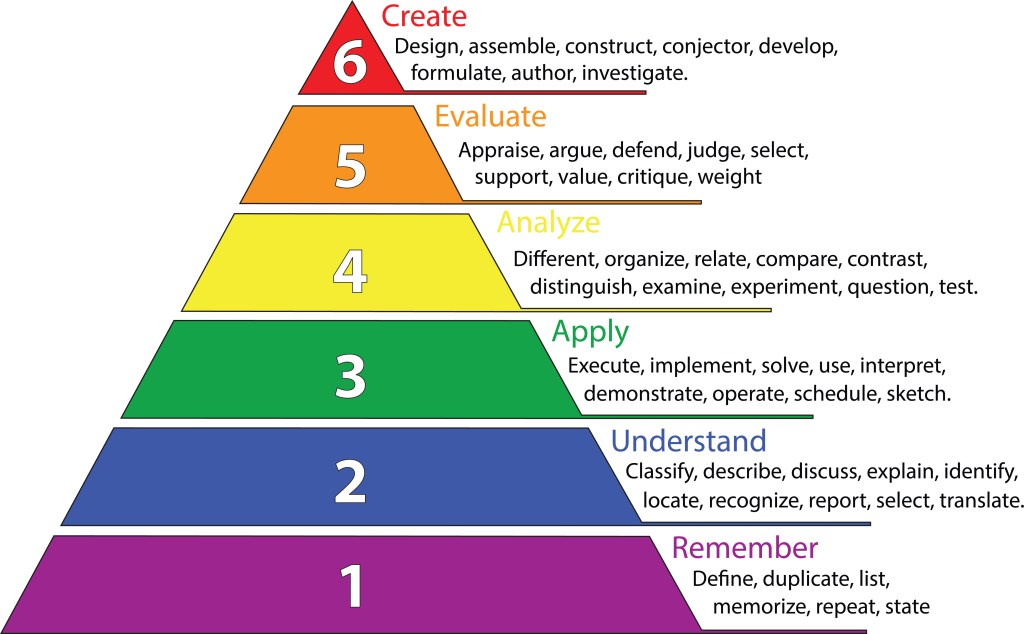
1. Remembering: Involves recalling information such as facts, terms, or basic concepts. It’s about ensuring learners have a foundational understanding of key concepts.
2. Understanding: Involves grasping the meaning of information, allowing learners to explain concepts in their own words and demonstrate comprehension.
3. Applying: Involves using knowledge in new and practical situations, like solving problems or completing tasks. It focuses on the application of principles or procedures in real-world scenarios.
4. Analyzing: Encourages critical thinking as learners break down information into component parts, identifying patterns, relationships, or underlying structures.
5. Evaluating: Involves making judgments or assessments based on criteria, allowing learners to critique, appraise, and defend their viewpoints.
6. Creating: Involves generating new ideas, products, or solutions, and encourages learners to design, invent, or construct new knowledge.
 Better Learning Design